
UniNote: Unified Multimodal Embeddings
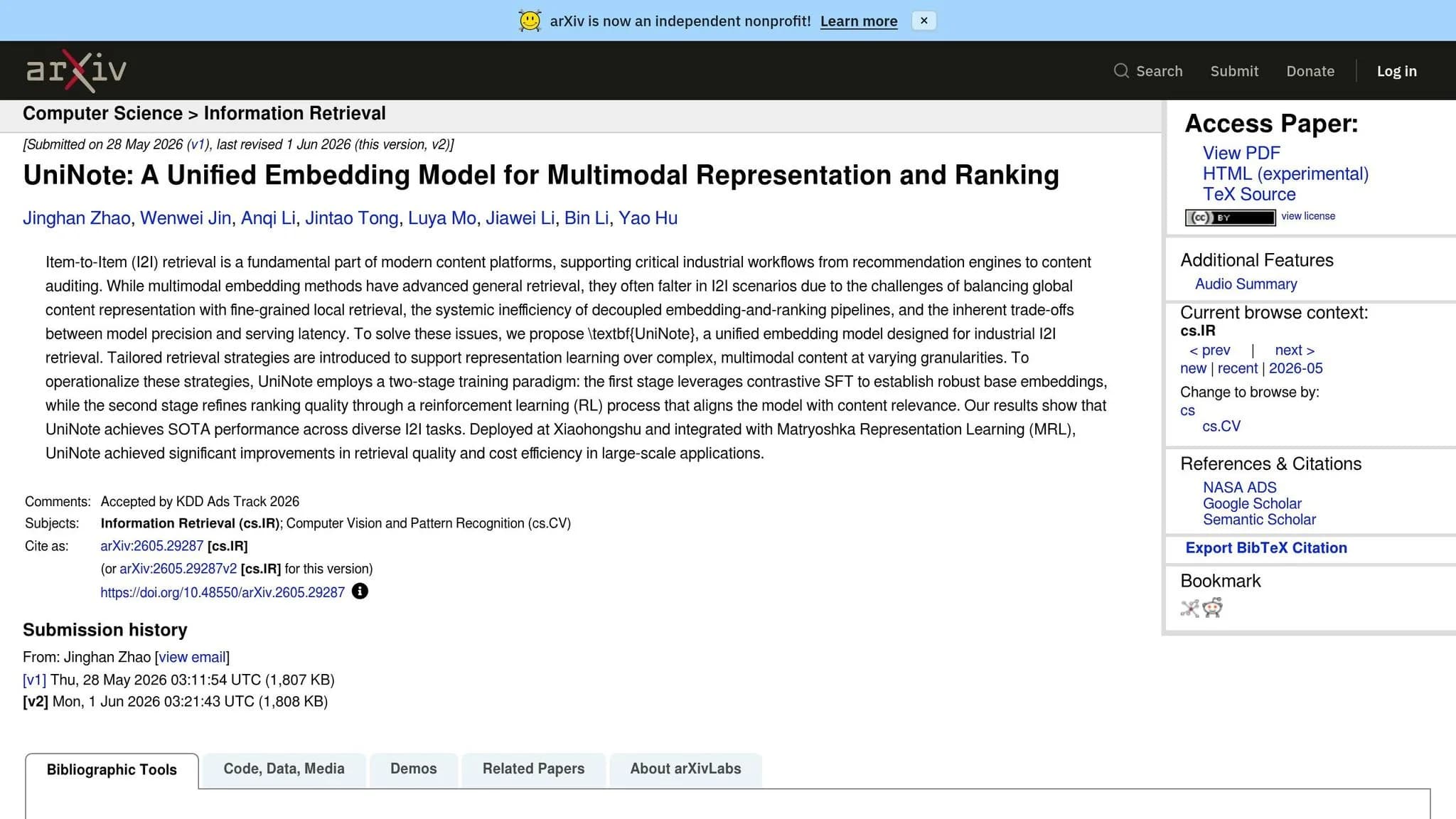
Explore how Xiaohongshu’s UniNote maps text, images, audio, and video into one shared embedding space for unified retrieval, ranking, and search.
Xiaohongshu’s main idea is simple: one note, one embedding, one search path. Instead of handling text, images, video, and audio in separate systems, UniNote puts them into one shared vector space for both retrieval and ranking.
If I boil the article down, here’s what matters most to me:
- UniNote creates one multimodal embedding per note
- It uses two training stages, including InfoNCE loss and hard negative mining
- It aims to use the same embedding system for retrieval and ranking
- The goal is to make cross-modal search work better, like matching a photo to a product page or a video clip
- The article points to cross-modal retrieval gains, including a cited result of up to 26 percentage points in NDCG@10 from related shared-space work
- The limits are still clear: fine-grained mismatches, video time-window limits of 3 to 25 seconds, and ranking errors when signals do not line up
In other words, this is less about adding another model and more about cutting split pipelines across media types. For teams working on search, feeds, or shopping discovery, that can mean one index, simpler system flow, and fewer mismatches between retrieval and ranking.
What I take from it is straightforward: shared embeddings can make multimodal search simpler to run, but alignment quality still decides whether results feel right.
Qwen3-VL-Embedding and Qwen3-VL-Reranker: A Unified Framework for State-of-the-Art Multimodal Retrie
How UniNote Works: Architecture, Training, and Retrieval-Ranking Design
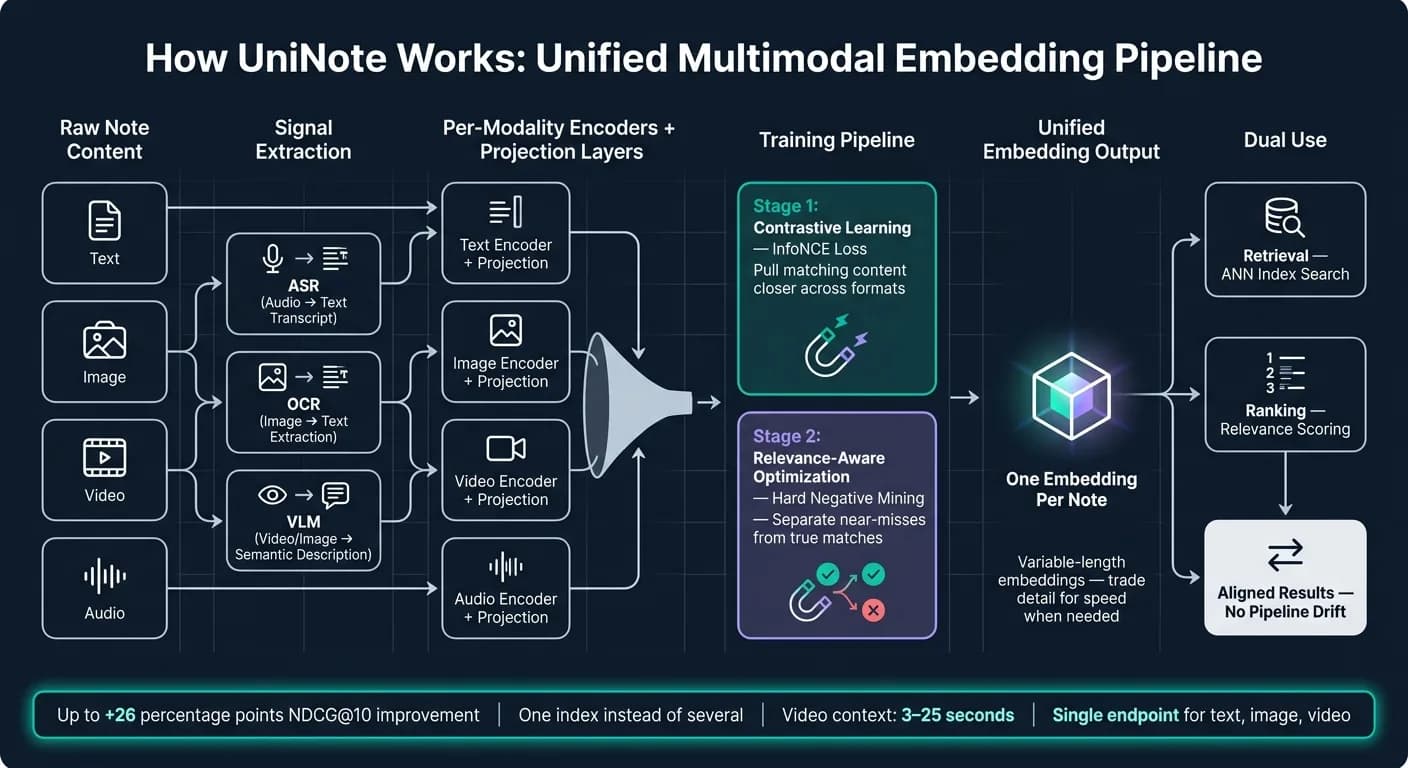
Unified Note Representation Across Modalities
UniNote turns audio, images, and video into a shared note format by using ASR, OCR, and VLMs first, then mapping those signals into one common vector space. Each modality goes through its own encoder, and trainable projection layers move those outputs into a single high-dimensional space. The end result is one embedding per note, built from whatever signals the note contains.
That setup gives Xiaohongshu one pipeline for search across text, images, video, and audio. Instead of treating each format like a separate island, the system puts them on the same map.
Of course, that only works if the model learns strong alignment across formats.
Two-Stage Training and Hard Negative Mining
UniNote uses a two-stage approach.
In the first stage, it applies contrastive learning with InfoNCE loss. This teaches the model to pull matching content closer together, even when that content appears in different formats.
In the second stage, the focus shifts to ranking quality through relevance-aware optimization and hard negative mining. Hard negatives are items that look close in context but are still wrong in meaning. That matters a lot. If a model can separate near-misses from actual matches, ranking gets sharper.
UniNote also uses variable-length embeddings. That means embeddings can be shortened when a task doesn't need full precision. In plain English, the system can trade a bit of detail for less storage use and faster retrieval.
The same embedding can then handle both candidate retrieval and final ranking.
Why One Model for Retrieval and Ranking Simplifies System Design
A lot of recommendation systems use one model for retrieval and another for ranking. On paper, that sounds neat. In practice, it can create drift between stages, where one model learns one idea of relevance and the other learns something slightly different.
UniNote avoids that split. It uses one embedding framework for both retrieval and ranking, which keeps the two stages aligned. That shared setup is what helps retrieval and ranking behave the same way in production.
The next question is how well that design performs on real retrieval tasks.
What the Research Shows: Tasks, Results, and Current Limits
Item-to-Item Retrieval Tasks and Benchmark Scope
UniNote was tested on item-to-item retrieval tasks. In plain English, that means the model tries to match the same or related content across different formats inside one shared embedding space.
The core test is pretty simple: can one embedding connect content across formats without sending retrieval through separate pipelines? That matters more than it might sound at first. The same embedding has to do double duty. It needs to support both retrieval and ranking, while still keeping the meaning between modalities intact.
Performance Gains Across Cross-Modal Retrieval
On retrieval benchmarks, UniNote tests whether a single shared space can improve match quality without relying on separate pipelines for each modality. GR-CLIP, which re-centers clusters in a shared embedding space, improved NDCG@10 by as much as 26 percentage points compared with standard CLIP[1].
That’s not a small bump. In retrieval systems, even modest movement in ranking metrics can change downstream recommendations in a noticeable way.
Still, there’s no free lunch. Those gains come with trade-offs.
Where Unified Embeddings Still Fall Short
Unified embeddings still run into trouble when modalities don’t line up cleanly. When that happens, the system can misrank results or produce errors that feel a bit like hallucinations. Performance can also slip on fine-grained content, especially when visual and text signals pull in different directions.
Video is another sticking point. Many systems still work with only 3 to 25 seconds of temporal context, which puts a hard cap on how much sequence-level meaning they can use.
That becomes a bigger problem in fast-moving search and recommendation systems handling mixed-format content at scale.
Practical Uses in Search, Recommendation, and Multimodal AI Workflows
Those retrieval gains only matter if they make search and recommendation easier to run in production.
Cross-Modal Search and Recommendation for Social Commerce and Media
The main use case for UniNote-style embeddings is product discovery and content matching. With a unified embedding system, one query can match a shopper photo to a product listing, a creator review, or a short video without forcing teams to build separate pipelines for each format.
That matters a lot in social commerce and media. A person might upload a screenshot, paste a caption, or search with a product name. If all of those inputs live in the same embedding space, the system has a much better shot at returning related items across text, images, and video.
It also helps with recommendation. Related posts, captions, and clips stay close enough together to support tighter content clustering and better feed suggestions. And from an ops point of view, teams can keep one index instead of several, which cuts a lot of extra moving parts.
Multimodal Indexing, Latency, and Infrastructure Considerations
Moving to a unified embedding model changes indexing in a pretty direct way. Instead of running separate vector stores for text, images, and video, teams can consolidate them into a single approximate nearest neighbor (ANN) index. That simplifies query routing and trims operational overhead.
Video adds another layer. Teams need preprocessing that keeps timing signals intact without making retrieval slow. In practice, that usually means:
- Sampling frames
- Encoding clips through the same multimodal pipeline
- Keeping retrieval fast enough for production use
This setup also cuts model-integration overhead. You’re not wiring up one path for text, another for images, and yet another for video. The pipeline gets simpler, and that usually means less maintenance pain later.
How APIMart Fits Into Unified Multimodal Workflows
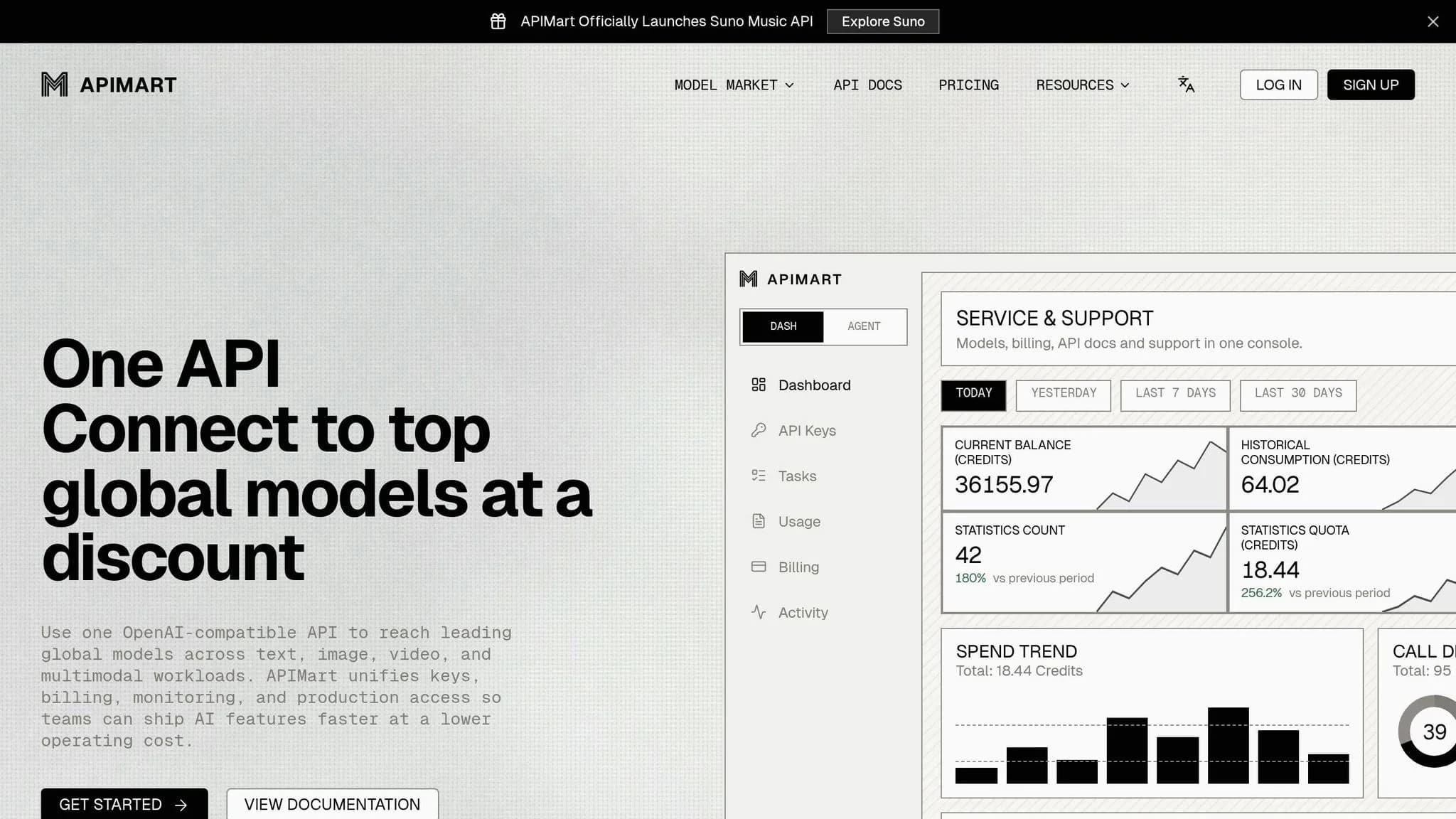
APIMart exposes text, image, and video models through one OpenAI-compatible endpoint (api.apimart.ai/v1). That reduces contract, auth, and rate-limit overhead.
For teams building multimodal workflows, this means one integration layer can handle different model types without rewriting the plumbing each time. The engineering focus stays on embedding logic and business logic, not on API management.
Key Takeaways for Developers and AI Teams
What to Take Away From UniNote
After the retrieval and infrastructure details, the main takeaway is operational: UniNote uses one semantic space to handle multimodal search and ranking. That matters because separate pipelines tend to create inconsistent results at scale.
In plain terms, you get fewer handoffs between modalities and fewer ranking mismatches. For developers, that means fewer moving parts in cross-modal search. Matching product images to descriptions, linking short-form videos to captions, and running multimodal search for social commerce all get simpler when the same embedding handles both retrieval and ranking, without separate models stitched together for each format.
The practical move is straightforward. Build indexing, retrieval, and recommendation around one shared semantic space so new modalities can plug in without forcing a pipeline rebuild. One index, one ranking logic, fewer integration points.
FAQs
How is one embedding built from mixed media?
UniNote and similar systems create a single embedding by mapping text, images, video, and audio into a shared semantic vector space.
They usually rely on transformer-based models to convert each input type into one unified representation. From there, they use cross-modal attention and projection layers so the same idea lines up across formats. That makes it possible for the system to measure semantic similarity between different kinds of media.
Why use the same embedding for retrieval and ranking?
Using the same embedding for retrieval and ranking keeps everything in one shared semantic space. That matters more than it may seem at first glance.
When text, images, and video are mapped in the same way, you can compare them directly. A written query can line up with an image. A video can match a text description. Related content stays in sync across formats instead of drifting apart.
That leads to better cross-modal search and retrieval, cuts down the modality gap, and helps recommendation pipelines stay steady and consistent.
What are UniNote’s biggest limits today?
UniNote runs into its biggest limits when it tries to place text, images, video, and audio into one shared semantic space. That sounds clean in theory. In practice, these modalities don't line up on their own, so training gets tougher and the learned representations can be weaker.
There's another issue during joint training: modality laziness or clash. In plain English, the model may lean too hard on the easiest input and give less attention to the others. That can leave some modalities undertrained. And when real-world data is incomplete, like missing audio, the problem gets worse. The model may perform worse overall or depend too much on the one modality that happens to be strongest.
Choose the model you want in the model marketplace
Try chat, image and video models in the APIMart model marketplace, and experience model capabilities quickly with one unified API.