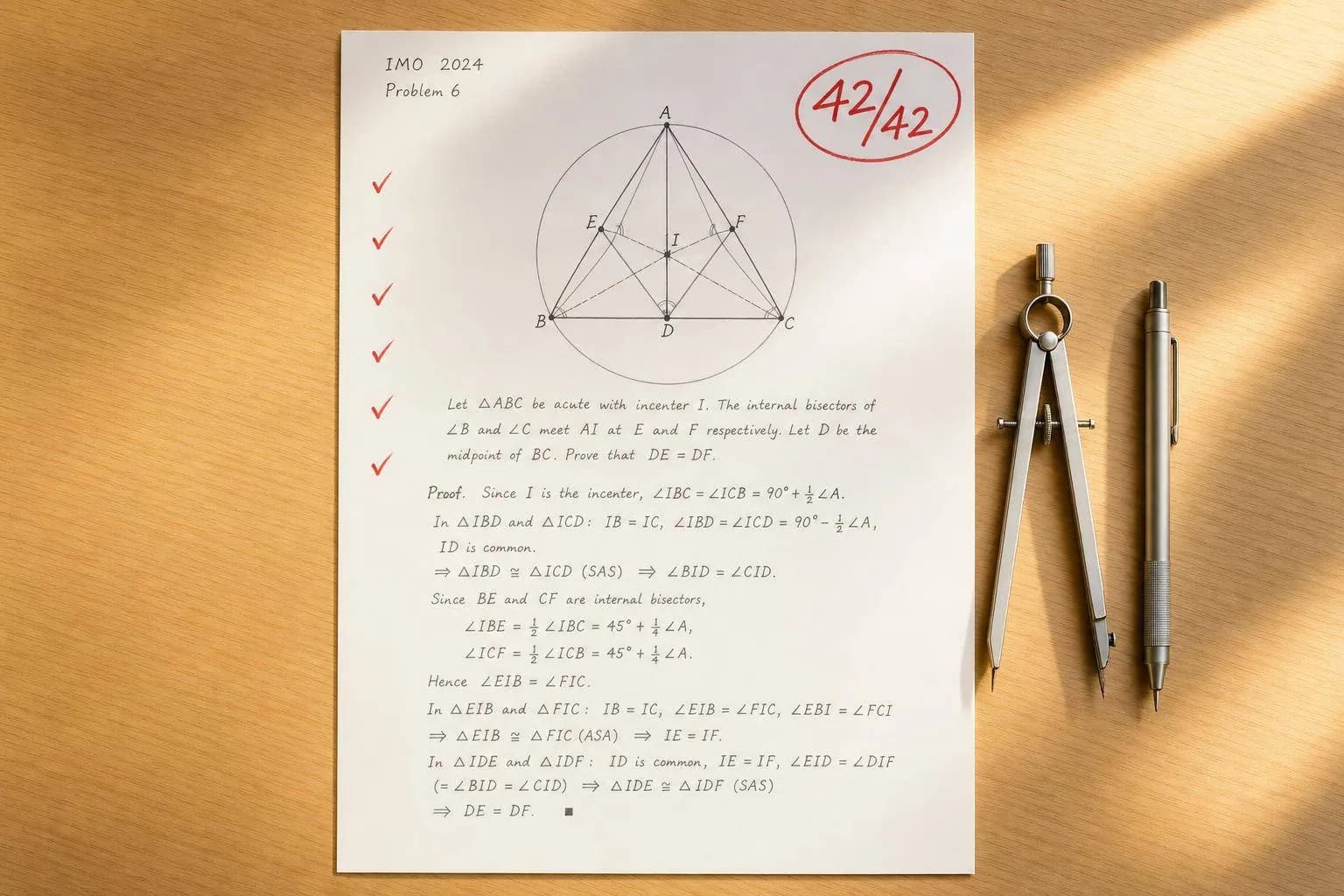
dots-note-3.0 Achieves a Perfect IMO Score
Xiaohongshu’s dots-note-3.0 reportedly scored 42/42 at the 2026 IMO. See how its proof-writing workflow uses self-checking and Python validation.
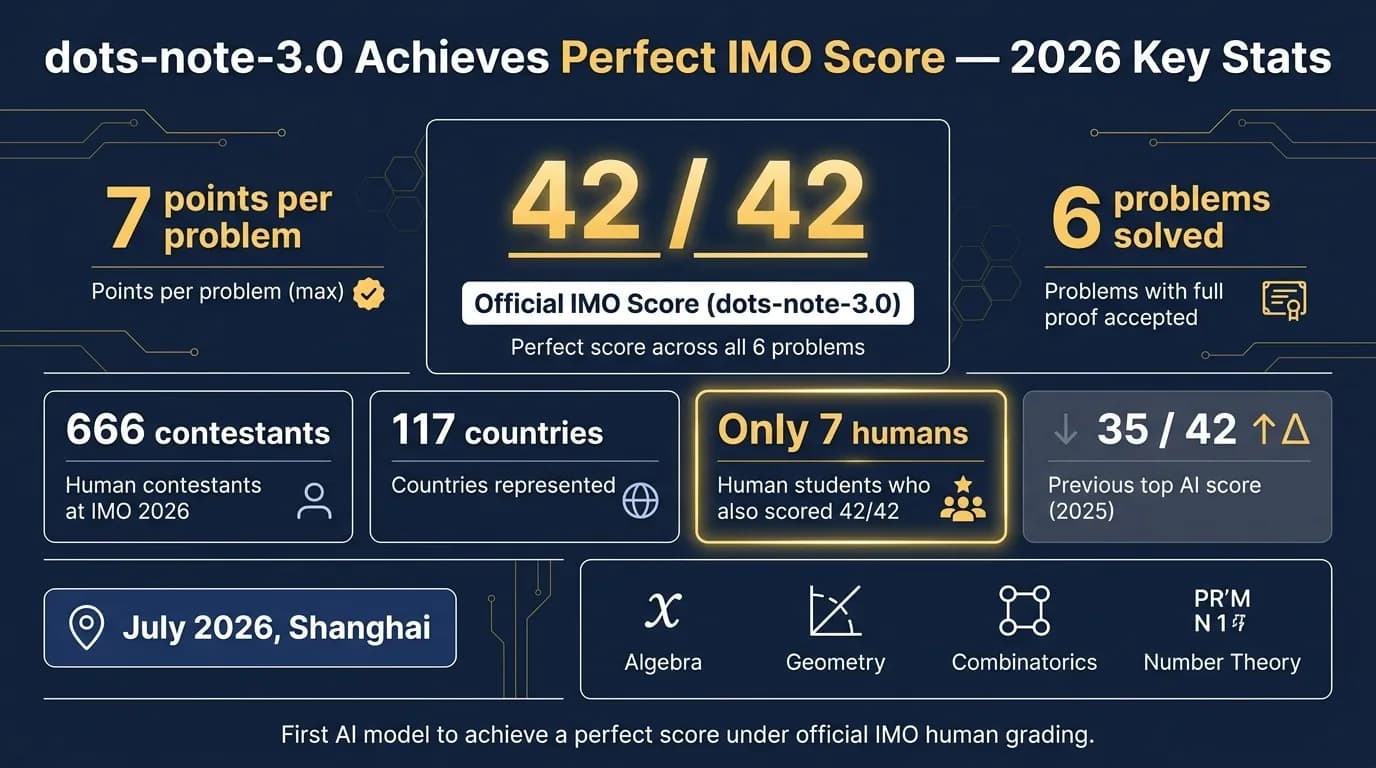
An AI model got a perfect 42/42 on the 2026 IMO under official human grading. That means Xiaohongshu’s dots-note-3.0 didn’t just get final answers right - it wrote six complete proofs that graders accepted.
Here’s the short version:
- Date: July 2026
- Event: International Mathematical Olympiad in Shanghai
- Score: 42 out of 42
- Human comparison: only 7 of 666 students also got a perfect score
- What changed: the prior top AI result was 35/42 in 2025
- Why people care: the IMO tests long, step-by-step proof writing, not answer guessing
If I put it simply: this result shows that AI proof writing has moved to a new level in one very hard test. That does not mean AI is flawless in daily use. IMO problems are clean and structured. Normal tasks often are not.
What stands out to me is the model’s workflow. It read raw LaTeX, built proofs across algebra, geometry, combinatorics, and number theory, and used a self-checking loop with text reasoning and Python checks before submission. That matters because the same kind of step control can help in systems where one model’s output feeds another.
So if you want the plain-English takeaway, it’s this: dots-note-3.0 hit a rare math contest score, and the bigger story is proof quality, not just math skill.
For the first time, an AI model has scored a perfect 100% at the International Mathematical Olympiad
The IMO benchmark and dots-note-3.0's official result

The IMO is a two-day, six-problem proof contest for students under 20. Each problem is worth 7 points, so the top score is 42. And this isn't the kind of math contest where the right final number gets you full credit. To score well, contestants have to show full, logically sound proofs. Partial credit depends on how complete the proof is.[5][3]
In July 2026, the IMO took place in Shanghai with 666 contestants from 117 countries. After the human contest ended, Xiaohongshu ran dots-note-3.0 under the official grading rules, with no human intervention, and submitted its solutions for official grading. The model earned 7 out of 7 on all six problems, for a perfect 42 out of 42.[1][2][4]
That detail matters. A perfect IMO score doesn't mean the solver got the answers right by luck or pattern matching. It means the submitted work held up as complete proof-based reasoning from start to finish.
How a perfect 42 out of 42 is scored
A perfect 42/42 means every proof has to be complete. No missing steps. No logical gaps. No skipped conditions. IMO graders judge the quality of the reasoning itself, not just the endpoint.[5][3]
Put simply, the bar is high. The solver has to carry a clean chain of logic across all six problems and do it in a way that survives official review.
Why this result is historically significant
This is the first large language model to receive a perfect score under official IMO judging.[1][4]
What capabilities dots-note-3.0 had to demonstrate
To earn 42/42, dots-note-3.0 had to do more than land on the right answer. It had to read raw LaTeX problem statements, choose a proof path, and then write a complete proof that human graders could check within the contest time limit. [1] So the format of the input and the quality of the proof mattered just as much as the final result.
Reading LaTeX problems and writing full proofs
dots-note-3.0 worked directly from raw LaTeX statements and produced full, human-readable proofs that official graders score. [1] That jump - from raw statement to verified proof - is where deeper reasoning starts to show.
Multi-step reasoning across algebra, geometry, combinatorics, and number theory
Solving all six IMO problems means showing broad reasoning ability across algebra, geometry, combinatorics, and number theory. [1][2] In plain terms, that means building geometric arguments, proving facts about integers, working through combinatorial case splits, and linking intermediate lemmas into one valid line of reasoning.
Some 2026 problems also used story-style framing, so the model had to strip away the narrative and get to the math underneath. [1]
Examples of tasks this level of reasoning can handle
Here’s what that level of reasoning looks like in practice:
| Domain | Example Task |
|---|---|
| Geometry | Build geometric arguments from a given configuration |
| Number Theory | Prove properties of integers |
| Combinatorics | Work through case splits to count or rule out valid arrangements |
| Algebra | Chain identities and lemmas to reach the only valid conclusion |
The model also had to show why the conclusion must be true in a form that meets official IMO judging standards. [1][2] Those same proof skills are a big reason this result matters for broader AI reasoning research.
Why this result matters for AI reasoning research
The IMO is unusually hard for AI because it isn't a multiple-choice test. Contestants need to write full, step-by-step proofs, and even one missed case or one left-out condition can cost points. So this benchmark tests end-to-end proof validity, not just whether the final answer looks right.
That's a big deal. Answer-only benchmarks can hide weak reasoning if a model lands on the right result for the wrong reason. The IMO doesn't let that slide. It checks whether the model can hold the logic together from start to finish.
What this says about advanced reasoning accuracy
A perfect 42/42 suggests the model could map out a proof, check its own middle steps, and finish each argument without snapping the logical chain. In plain English: it points to stronger self-checking across long proofs.
The jump also stands out in context. In 2025, top systems reached 35/42, so 42/42 is a clear move up in proof completeness [3].
The harder question is how much of that reasoning carries over beyond contest math.
Why benchmark limits still matter
A perfect IMO score still doesn't prove broad reliability in messy day-to-day settings. Competition problems are structured. Real inputs often aren't. They can be noisy, vague, or missing key details [6].
So the result is strong evidence of advanced mathematical reasoning. But it shouldn't be read as a promise of general-purpose understanding.
That same consistency is what makes advanced reasoning useful in multi-modal and API-driven workflows.
How IMO-level reasoning can apply to multi-modal and API-driven applications
Where strong reasoning helps in real workflows
That level of consistency matters most when reasoning is just one part of a larger pipeline. In production, one missed constraint can throw off the whole result. A research assistant, tutoring tool, or coding agent all face the same job: keep every constraint in place from start to finish.
That’s where a self-checking loop helps. It can catch small mistakes early, before they snowball into bigger failures.
Using APIMart to combine reasoning with video, image, and language models

In multi-modal pipelines, a reasoning model can check the input before it reaches a video or image generator. The same idea works when reasoning needs to act as a gate before media generation starts.
APIMart lets teams combine reasoning, image, video, and language models through one API. That means teams can validate inputs first, then send them to a video model.
In day-to-day use, reasoning accuracy becomes a reliability layer for multi-modal pipelines. That’s why IMO-level reasoning matters beyond math: it helps multi-modal systems get checked, routed, and used with more confidence.
Conclusion: A verified reasoning milestone with practical takeaways
dots-note-3.0 scored a perfect 42 out of 42 at the 2026 International Mathematical Olympiad (IMO). This is the first time an AI model has hit that mark under official human grading, where human judges read and score every line of every proof [1][7].
The model wrote full proofs for the entire IMO set with no human help. It used an iterative loop with text reasoning and Python checks to test, revise, and tighten its own proofs before the final submission [7]. The part that stands out most is this: the model could check its own work and fix mistakes along the way.
For APIMart users building multi-modal workflows, that's the big lesson. IMO-level proof writing doesn't mean perfect reliability in every use case. But it does point to something important. Verifiable reasoning is getting closer to something teams can depend on in production workflows.
Put simply, self-checking reasoning can improve trust in APIMart workflows that bring together language, image, and video models.
FAQs
Why is a perfect IMO score such a big deal for AI?
A perfect score at the International Mathematical Olympiad (IMO) matters because it points to something bigger than pattern matching. The IMO doesn't just ask for answers. It asks for full mathematical proofs.
So when a model scores 42 out of 42, that's not a small feat. It means the model can build long, step-by-step arguments and keep them intact from start to finish, without logical errors, missing conditions, or unsupported claims.
That level of precision matters when reasoning has to happen across many steps, not just in a single jump.
Does this mean dots-note-3.0 is reliable outside math contests?
A perfect International Mathematical Olympiad score points to strong, error-free logical reasoning. But it doesn't guarantee reliability in every real-world scenario.
The IMO tests a narrow kind of mathematical reasoning under strict conditions. dots-note-3.0 should still be checked against your actual production workloads, criteria, and traffic patterns before full deployment.
How can IMO-level reasoning help real AI workflows?
IMO-level reasoning helps in real AI workflows because it pushes the model to work through hard problems step by step, not just spit out an answer at the end. That matters a lot for multi-step math, where one small mistake early on can throw off everything that follows.
It also makes it easier to check the work in the middle. Instead of treating the result like a black box, you can inspect each step, spot weak links, and catch proof or logic mistakes before they spread.
In day-to-day use, that can mean fewer failures in tool-using systems, better accuracy when the model has to work within tight constraints, and stronger support for advanced multimodal or API-driven apps that rely on steady logical consistency.
Choose the model you want in the model marketplace
Try chat, image and video models in the APIMart model marketplace, and experience model capabilities quickly with one unified API.