
Cohere-Modelle unter Apache 2.0 und selbst gehostete KI
Entdecken Sie Coheres Modell-Roadmap unter Apache 2.0 für Text, Sprache, Code und mehrsprachige KI sowie die Vorteile und Kompromisse einer selbst gehosteten Bereitstellung.
Wenn Sie KI innerhalb Ihres eigenen Technologie-Stacks betreiben möchten, macht die Roadmap von Cohere vom Juli 2026 dies deutlich einfacher. Ich würde es so zusammenfassen: Cohere stellt weitere Modellfamilien unter Apache 2.0. Dadurch können Sie diese kommerziell einsetzen, verändern und selbst hosten, ohne dass Lizenzprobleme die KI-Projekte Ihres Unternehmens ausbremsen.
Hier ist die Kurzfassung:
- Was sich geändert hat: Cohere bietet nun Modelle unter Apache 2.0 für Text-, Sprach-, Code- und mehrsprachige Anwendungsfälle.
- Welche Modelle wichtig sind: Command A+, Cohere Transcribe, North Mini Code und Teile der Aya-Familie.
- Warum Teams das wichtig finden: Apache 2.0 erlaubt, die Modellgewichte auch für kostenpflichtige Produkte zu nutzen, zu verändern und weiterzugeben.
- Wofür Sie weiterhin verantwortlich sind: Sie müssen sich nach wie vor um Infrastruktur, Hinweise, Lizenzdateien und die Prüfung der Patentklausel kümmern.
- Wo diese Modelle eingesetzt werden können: On-Premises, in einer privaten VPC oder in hybriden Umgebungen, in denen private Daten lokal bleiben.
- Wer aufhorchen sollte: Teams, die mit PII, PHI, internen Dokumenten, regulierter Suche, privaten Assistenten oder On-Premises-Transkription arbeiten.
- Wichtige Zahlen aus dem Artikel:
- Command A+: 218B-MoE-Modell
- API-Preise für Command A+: $2.50 pro 1 Million Eingabetoken und $10.00 pro 1 Million Ausgabetoken
- Kontextfenster: 128K Token, eine Erweiterung auf 1 Million wird erwähnt
- WER von Cohere Transcribe: 5.42% gegenüber 7.44% bei Whisper Large v3
- Geschwindigkeit von Transcribe: etwa 525 Audiominuten pro Echtzeitminute
- Zugriff über APIMart: 500+ KI-Modelle über eine API
Für Sie bedeutet das ganz einfach: Wenn Ihr Team langfristig mehr Kontrolle über Daten, Bereitstellung und Kosten haben möchte, ist Coheres Open-Weight-Ansatz jetzt eine stärkere Alternative zu ausschließlich gehosteter KI.
Einen selbst gehosteten ChatGPT-Klon mit der KI von Cohere erstellen

Kurzer Vergleich
| Option | Kontrolle | Daten bleiben in Ihrer Umgebung | Anfänglicher Infrastrukturaufwand | Besonders geeignet für |
|---|---|---|---|---|
| Selbst gehostete Cohere-Modelle | Hoch | Ja | Hoch | Regulierte, private und isolierte Workloads |
| Hybrid mit APIMart | Mittel bis hoch | Ja, bei sensiblen Abläufen | Mittel | Teams, die private und externe Workloads trennen |
| Nur verwaltete API | Niedrig | Nein | Niedrig | Schneller Start und weniger interner Betriebsaufwand |
Die wichtigste Erkenntnis sehe ich so: Apache 2.0 beseitigt ein großes rechtliches Hindernis, aber Ihr Team benötigt weiterhin die passende GPU-, MLOps- und Compliance-Infrastruktur, damit Self-Hosting gut funktioniert.
Was sich an Coheres Modell-Roadmap ändert
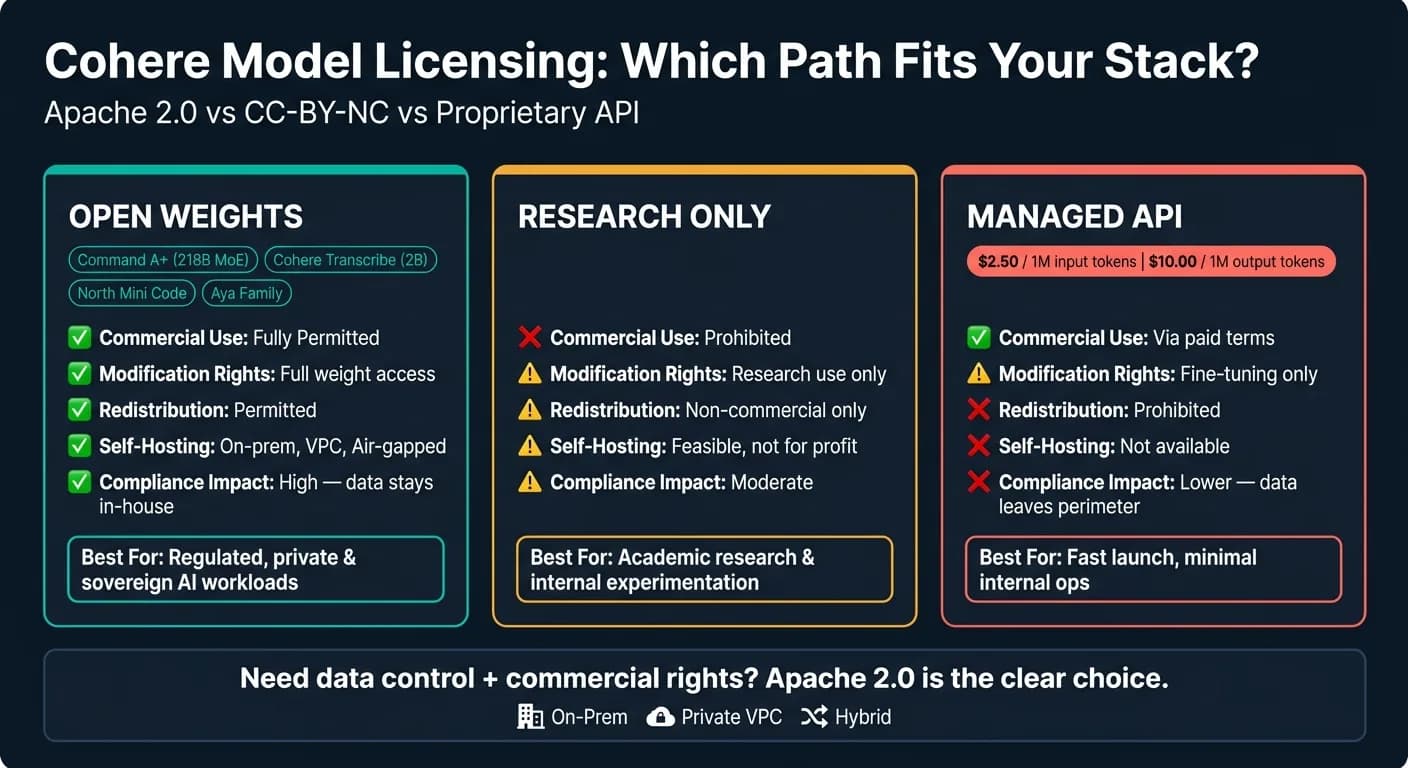
Cohere stellt mehrere führende Modellfamilien unter Apache 2.0. Dadurch können Teams diese wesentlich unkomplizierter selbst hosten, anpassen und kommerziell bereitstellen. Für Unternehmen ist die entscheidende Veränderung einfach: weniger Lizenzprobleme und mehr Freiheit, Modelle im eigenen Technologie-Stack zu betreiben.
Cohere-Modellfamilien, die unter Apache 2.0 wechseln
Im Juli 2026 stehen mehrere Modellfamilien von Cohere unter Apache 2.0:
- Command A+ – Dieses im Mai 2026 veröffentlichte Mixture-of-Experts-Modell (MoE) mit 218B Parametern umfasst W4A4-quantisierte Varianten, die den GPU-Speicherbedarf bei Unternehmensbereitstellungen senken [3][4].
- Cohere Transcribe – Eine Speech-to-Text-Modellfamilie mit 2B Parametern, die unter Apache 2.0 veröffentlicht wurde. Dazu gehören das im März 2026 eingeführte Basismodell und eine im Juli 2026 veröffentlichte, auf Arabisch spezialisierte Version [3][6].
- North Mini Code – Ein im Juni 2026 veröffentlichtes, auf Code spezialisiertes Modell, mit dem die Roadmap auf spezialisierte Coding-Gewichte ausgeweitet wird [5][7].
- Aya-Familie – Mehrsprachige Modelle wie Tiny Aya und Aya Vision, die für mehrsprachige lokale Anwendungen oder den Einsatz auf Endgeräten entwickelt wurden [3].
Das Muster ist unübersehbar. Cohere erweitert sein Open-Weight-Angebot für Textgenerierung, Spracherkennung, Programmierung und mehrsprachige Workloads.
Das ist wichtig, weil Apache 2.0 verändert, was Teams mit den Gewichten tun dürfen.
Gewichte unter Apache 2.0 gegenüber den Bedingungen einer gehosteten API
Unter Apache 2.0 erhalten Sie die Gewichte und können das Modell damit lokal ausführen und verändern. Die gehostete API folgt einem anderen Modell. In diesem Fall findet die Inferenz zu separaten kostenpflichtigen Bedingungen auf Coheres Infrastruktur statt. Command A+ kostet über die API beispielsweise $2.50 pro 1 Million Eingabetoken und $10.00 pro 1 Million Ausgabetoken [6].
Diese Trennung verändert den Kompromiss. Beim Self-Hosting übernimmt Ihr Team die Infrastrukturarbeit, dafür bleiben die Daten in Ihrer eigenen Umgebung. Mit der API ist die Bereitstellung einfacher, doch der Anbieter behält mehr Kontrolle darüber, wie das Modell ausgeführt wird.
Dieser Unterschied wird in der folgenden Tabelle besonders deutlich.
Lizenzvergleich: CC-BY-NC, proprietärer Zugriff und Apache 2.0
| Merkmal | Apache 2.0 (z. B. Command A+) | CC-BY-NC (Forschungsmodelle) | Proprietärer API-Zugriff |
|---|---|---|---|
| Kommerzielle Nutzung | Uneingeschränkt gestattet | Untersagt | Zu kostenpflichtigen Bedingungen gestattet |
| Änderungsrechte | Vollständiger Zugriff auf die Gewichte | Nur für Forschungszwecke gestattet | Auf Fine-Tuning beschränkt |
| Weitergabe | Gestattet | Für nicht kommerzielle Nutzung gestattet | Untersagt |
| Self-Hosting | Möglich – On-Premises, VPC, isoliert | Möglich, aber nicht gewinnorientiert | Nicht verfügbar |
| Auswirkungen auf Compliance | Hoch – Daten bleiben intern | Mittel – nur Forschungsnutzung | Geringer – Daten verlassen den eigenen Perimeter |
CC-BY-NC kann den Produktionseinsatz rechtlich unklar machen. Ein proprietärer API-Zugriff erleichtert die Einführung, die Kontrolle verbleibt jedoch beim Anbieter. Apache 2.0 eignet sich besser, wenn kommerzielle Nutzung, interne Modelländerungen und lokale Datenkontrolle auf der Prioritätenliste weit oben stehen.
Als Nächstes folgt der praktische Teil: Was Apache 2.0 Teams in der Produktion ermöglicht und welche Pflichten weiterhin bestehen.
Was Apache 2.0 erlaubt und warum Unternehmen das wichtig finden
Kommerzielle Nutzung, Änderung, Weitergabe und Patentbedingungen erklärt
Apache 2.0 gewährt Unternehmen eine unbefristete, weltweite und gebührenfreie Lizenz zur Nutzung, Änderung und Weitergabe des Modells [9]. Einfach ausgedrückt können Sie es ausführen, verändern und ausliefern, ohne Lizenzgebühren zu zahlen.
Für Unternehmen beseitigt dies viel Reibung, insbesondere wenn sie die Inferenz in ihrer eigenen Umgebung behalten möchten. Jede kommerzielle Nutzung ist erlaubt. Selbst gehostete Teams erhalten mit dieser rechtlichen Erlaubnis deutlich mehr Freiheit, das Modell dort und so bereitzustellen, wie sie es benötigen.
Teams können Modelle mit proprietären Daten feinabstimmen, ihr Verhalten an ein Fachgebiet anpassen und die Ausgaben mit interner Terminologie in Einklang bringen. Sie dürfen diese Änderungen zudem privat halten. Es besteht keine Verpflichtung, veränderte Gewichte zu veröffentlichen [9]. Das ist wichtig, wenn Ihre Modelländerungen internes Wissen oder Produktlogik widerspiegeln, die Sie nicht offenlegen möchten.
Die Patentlizenz bietet eine weitere Schutzebene. Sie deckt Patentansprüche ab, die durch das Modell notwendigerweise verletzt werden, endet jedoch, wenn Ihre Organisation einen Mitwirkenden wegen Patentverletzung verklagt [9][10]. Apache 2.0 gewährt außerdem keine Markenrechte, weshalb der Name Cohere nur zur Angabe der Quelle verwendet werden sollte [9][10].
Compliance-Pflichten, die Teams weiterhin erfüllen müssen
Ein gewisser Verwaltungsaufwand bleibt bestehen.
Wenn Sie das Modell oder abgeleitete Werke weitergeben, müssen Sie die Lizenz beilegen, die erforderlichen Hinweise beibehalten, eine vorhandene NOTICE-Datei übernehmen und veränderte Dateien klar kennzeichnen [9]. Rechtsteams sollten die Patentvergeltungsklausel frühzeitig prüfen. Gleichzeitig müssen MLOps-Teams sicherstellen, dass die Hinweise über sämtliche Build- und Release-Pipelines hinweg erhalten bleiben.
Sobald diese Bedingungen geklärt sind, stellt sich die nächste praktische Frage: Wo sollte das Modell ausgeführt werden?
Tabelle: Rechte unter Apache 2.0 und ihre geschäftlichen Auswirkungen
| Lizenzrecht | Was es rechtlich erlaubt | Geschäftlicher Vorteil |
|---|---|---|
| Kommerzielle Nutzung | Das Modell in jedem umsatzgenerierenden Produkt oder Dienst verwenden | Keine Lizenzgebühren |
| Änderung | Modellgewichte und Code feinabstimmen oder verändern | Proprietäre Fähigkeiten auf Open-Weight-Modellen aufbauen |
| Weitergabe | Das Modell oder abgeleitete Werke mit anderen teilen | Weniger Reibung für Produktteams bei der Auslieferung KI-gestützter Anwendungen |
| Patentlizenz | Patentansprüche von Mitwirkenden nutzen, die durch das Modell notwendigerweise verletzt werden | Schutz vor Patentansprüchen von Mitwirkenden |
| Gewährleistungsausschluss | Das Modell ohne Gewährleistung „wie besehen“ verwenden | Weniger Hürden beim Experimentieren |
Dieser Kompromiss führt direkt zu den Bereitstellungsoptionen On-Premises, VPC und Hybrid.
Selbst gehostete Cohere-Modelle bereitstellen und verwenden
Bereitstellungsoptionen: On-Premises, private VPC und Hybrid
Apache 2.0 ist nur dann relevant, wenn Sie das Modell dort ausführen können, wo sich Ihre Daten bereits befinden. Das ist die praktische Seite von Coheres Roadmap. Für die meisten Teams gibt es drei wesentliche Bereitstellungswege: On-Premises, innerhalb einer privaten VPC oder in einer hybriden Umgebung. Welche Option sinnvoll ist, hängt von Kontrolle, Compliance und Geschwindigkeit ab.
On-Premises-GPU-Cluster bieten Ihnen die größtmögliche Kontrolle über Daten. Bei Bedarf lassen sie sich vollständig vom Netz trennen. Da die Daten Ihr Netzwerk nie verlassen, bleibt außerdem die Inferenzlatenz niedrig. Mit W4A4-Quantisierung kann Command A+ auf nur zwei H100-GPUs ausgeführt werden. Damit wird eine On-Premises-Bereitstellung für Teams mit moderner GPU-Infrastruktur realistisch [4][8].
Bereitstellungen in einer privaten VPC verlagern diese Rechenleistung in eine isolierte Cloud-Umgebung. Sie erhalten weiterhin eine starke Trennung, ohne alles im eigenen Rechenzentrum betreiben zu müssen. Das passt häufig gut zu Enterprise-SaaS-Unternehmen und Finanzteams.
Hybride Umgebungen teilen die Arbeit auf. Sensibles Denken und Retrieval verbleiben in Ihrer eigenen Umgebung, während rechenintensivere externe Workloads eine API-Schicht durchlaufen. Dieses Modell ist häufig der Mittelweg, wenn ein Unternehmen nur in bestimmten Bereichen Privatsphäre benötigt.
| Bereitstellungsoption | Datenkontrolle | Latenz | Kostenart | Besonders geeigneter Anwendungsfall |
|---|---|---|---|---|
| On-Premises-GPU-Cluster | Maximal | Extrem niedrig | Investitionen (CapEx) | Isolierte Hochsicherheitsumgebungen |
| Private VPC (Cloud) | Hoch | Niedrig bis mittel | Betriebskosten (OpEx) | Regulierte Suche, RAG für Unternehmen |
| Hybride Umgebung | Hoch bei sensiblen Workloads | Variabel | Gemischt | Multimodale Anwendungen und Support-Workflows |
Diese Kompromisse werden bei privaten Assistenten, regulierter Suche und internen API-Schichten am deutlichsten.
Anwendungsfälle: private Assistenten, regulierte Suche und On-Premises-APIs
Die Wahl der Bereitstellung gewinnt schnell an Bedeutung, wenn der Workload Daten umfasst, die keinesfalls nach außen gelangen dürfen. In Unternehmen treten drei Muster immer wieder auf.
Private Assistenten für Mitarbeitende sind häufig der erste Schritt. Eine Rechts- oder Personalabteilung kann interne Richtlinien, Verträge oder Leitfäden zu Zusatzleistungen an eine selbst gehostete Command A+-Instanz senden. Das Modell beantwortet anschließend Fragen mit Retrieval-Augmented Generation (RAG) auf Grundlage dieser Dokumente, während der gesamte Workflow in der Unternehmensumgebung verbleibt. Command A+ unterstützt ein Kontextfenster von 128K Token, das möglicherweise auf 1 Million Token erweitert wird [8].
Regulierte Wissenssuche ist die nächste Stufe. Organisationen im Gesundheitswesen und Finanzinstitute müssen häufig Datensätze durchsuchen, die strengen Vorgaben zum Datenspeicherort unterliegen. In einer solchen Umgebung kann ein selbst gehostetes Cohere-Modell Embedding, Retrieval und Reranking übernehmen, ohne Daten außerhalb des eigenen Perimeters zu senden.
On-Premises-API-Schichten gehen noch einen Schritt weiter. Teams können interne Endpunkte für Aufgaben wie Dokumentklassifizierung, Transkription und Zusammenfassung entwickeln. Hier hebt sich Cohere Transcribe ab. Es erzielt auf dem Open ASR Leaderboard eine Wortfehlerrate von 5.42% und liegt damit vor Whisper Large v3 mit 7.44%. Zudem kann es etwa 525 Audiominuten pro Echtzeitminute verarbeiten [1][3]. Für Callcenter und Compliance-Aufzeichnungen ist es damit eine praktische Option und nicht bloß eine Labordemonstration.
Wenn nur ein Teil des Stacks privat bleiben muss, kann eine hybride API-Schicht den Rest übernehmen.
Die Rolle von APIMart in einer hybriden Umgebung
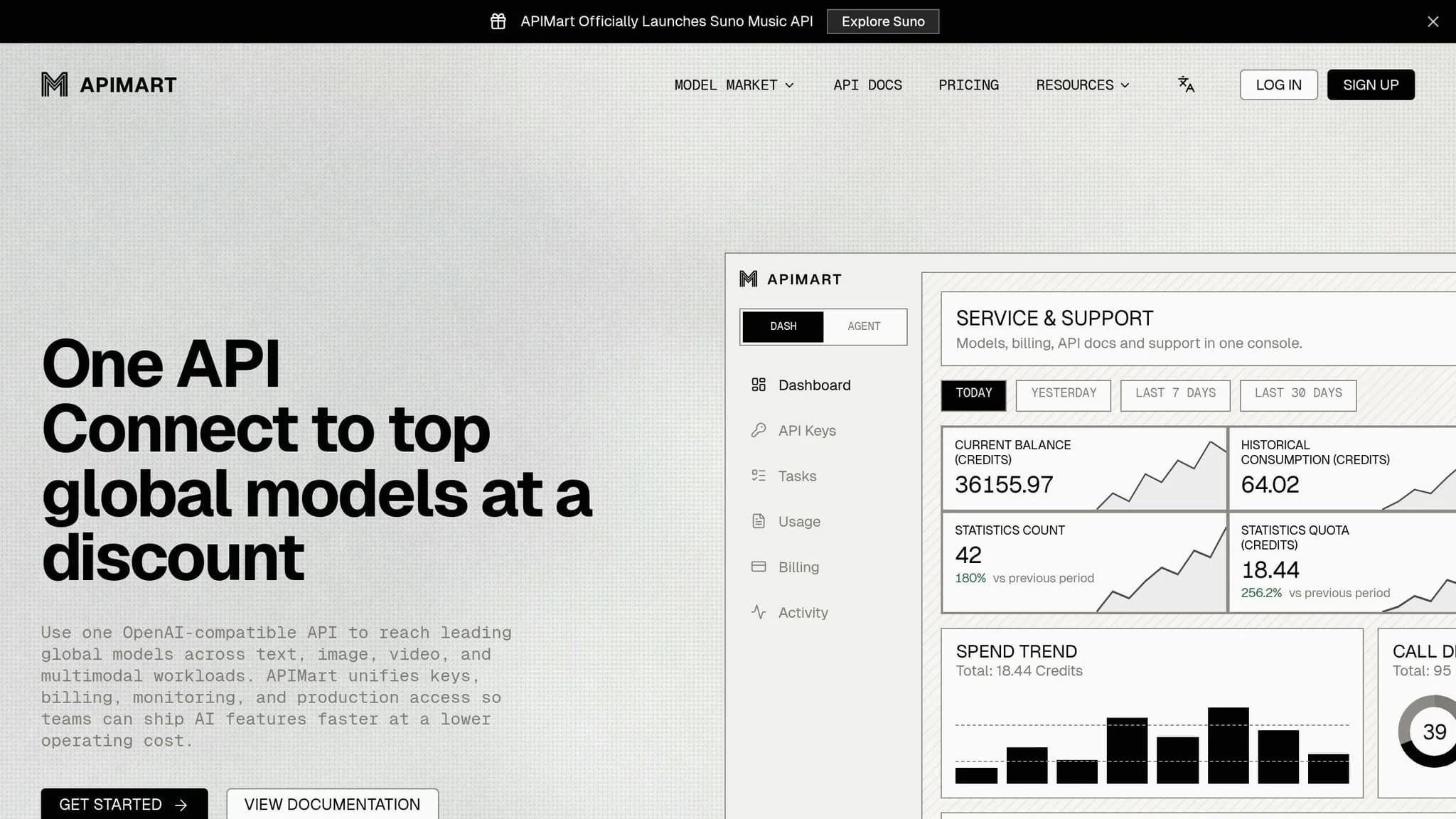
In einer hybriden Architektur fungiert APIMart als zentrale API-Schicht für nicht sensible Video-, Bild- und Sprach-Workloads, während sensibles Denken, Retrieval und private Daten in der selbst gehosteten Umgebung des Kunden verbleiben. Teams erhalten über eine API Zugriff auf 500+ KI-Modelle. Dadurch können sich interne Cohere-Bereitstellungen auf Workflows mit privaten Daten konzentrieren, statt in zahlreiche getrennte externe Integrationen auszuufern.
Diese Aufteilung ist einfach, aber nützlich: Sensibles Denken bleibt lokal, nach außen gerichtete Aufgaben laufen über einen einzigen Verbindungspunkt.
| Geschäftsproblem | Modellplatzierung | Wichtigster Vorteil | Datensensibilität |
|---|---|---|---|
| Regulierte Wissenssuche | Private VPC / On-Premises | RAG über interne Dokumente ohne Datenabfluss | Hoch |
| Privater Assistent für Mitarbeitende | Private VPC | Sichere agentische Workflows für Personal- und Rechtsaufgaben | Mittel bis hoch |
| On-Premises-API-Schicht | On-Premises | Transkription und Dokumentanalyse mit niedriger Latenz für PII/PHI | Hoch |
| Video- und multimodale Inhalte | APIMart (API) | Zugriff auf 500+ Modelle über einen Endpunkt | Niedrig bis mittel |
| Mehrsprachige Support-Abläufe | Hybrid | Unterstützung für 48 Sprachen, sensible Daten bleiben lokal | Mittel |
So entscheiden Sie, ob Coheres offene Roadmap zu Ihrem Stack passt
Entscheidungskriterien: Kontrolle, Compliance, Kosten und MLOps-Kapazität
Sobald Sie Ihre Bereitstellungsoptionen kennen, ist der nächste Schritt einfacher: Wählen Sie das Modell, das Ihr Team langfristig betreiben und unterstützen kann.
Das beste Modell ist nicht nur dasjenige mit starken Benchmark-Ergebnissen. Es ist das Modell, mit dem Ihr Team in den nächsten 12 bis 24 Monaten dauerhaft arbeiten kann. Meist klären vier Fragen die Entscheidung schnell.
Wie sensibel sind Ihre Daten? Wenn Ihre Workflows PHI, PII oder rechtlich geschützte Dokumente umfassen, sind Self-Hosting oder eine private VPC häufig unverzichtbar. Bei weniger sensiblen Workloads kann eine verwaltete API ausreichen.
Wie ausgereift ist Ihr MLOps-Team? Wenn Sie Coheres Modelle unter Apache 2.0 On-Premises betreiben, ist Ihr Team für die Kubernetes-Orchestrierung, die Beschaffung von GPUs und Arbeiten zur Modelloptimierung wie die Quantisierung verantwortlich [11]. Das ist keineswegs trivial. Der Betriebsaufwand ist beträchtlich.
Wie sieht Ihr Budget für die nächsten 12 bis 24 Monate aus? Ein gehosteter API-Zugriff kostet anfangs meist weniger. Beim Self-Hosting verlagert sich ein größerer Teil der Ausgaben auf Infrastruktur und laufenden Betrieb.
Benötigen Sie eindeutige kommerzielle Rechte für Ihre Produkte? Apache 2.0 bietet Teams diese Klarheit für kommerzielle Nutzung, Änderung und Weitergabe [2].
Für viele Teams in den USA liegt eine hybride Umgebung genau im optimalen Bereich. APIMart kann den breiteren multimodalen Zugriff abdecken, während sensibles Denken lokal bleibt.
Vergleichstabelle: ausschließlich selbst gehostet, hybrid mit APIMart oder verwaltete API
Nutzen Sie diese Tabelle, um Kontrolle, Compliance, Budget und MLOps-Kapazität der passenden Bereitstellungsform zuzuordnen.
| Ausschließlich selbst gehostet | Hybrid mit APIMart | Verwaltete API | |
|---|---|---|---|
| Priorität der Kontrolle | Maximal | Hoch bei sensiblen Workloads | Niedrig (vom Anbieter verwaltet) |
| Compliance / Datenspeicherort | Vollständige Netzwerkisolierung möglich | Sensible Daten bleiben lokal | Standard (SOC 2/ISO 27001) |
| Budgetprofil | Hohe CapEx und laufender Betrieb | Gemischte CapEx/OpEx | Reine nutzungsbasierte OpEx |
| MLOps-Aufwand | Hoch | Mittel | Minimal |
| Besonders geeignet für | Regulierte, souveräne KI, isolierte Umgebungen | Enterprise-RAG und multimodale Workflows | Start-ups, schnelle Prototypenentwicklung |
Fazit: die praktische Erkenntnis für Teams in den USA
Coheres Roadmap unter Apache 2.0 bietet Teams mehrere Wege nach vorn, ohne allen dieselbe Umgebung aufzuzwingen.
Ein Start-up kann mit einem verwalteten API-Zugriff beginnen und später zum Self-Hosting übergehen, wenn Datensensibilität oder Skalierung dies erfordern. Ein reguliertes Unternehmen kann den vollständigen Stack vom ersten Tag an On-Premises betreiben. Ein mittelständisches Team kann den Mittelweg wählen: Sensibles Retrieval und Denken bleiben lokal, APIMart übernimmt umfassendere multimodale Workflows.
Die am besten geeignete Architektur entspricht Ihren tatsächlichen Compliance-Anforderungen, der Infrastrukturkapazität Ihres Teams und Ihrem Budget für die nächsten ein bis zwei Jahre.
FAQs
Welche Cohere-Modelle stehen jetzt unter Apache 2.0?
Zu Coheres aktuellen Modellen unter Apache 2.0 gehören Command A+ und Transcribe.
Diese Veröffentlichungen unterstützen kommerzielle Nutzung, lokale Bereitstellung und Anpassungen in privater Infrastruktur. Dadurch erhalten Organisationen mehr Kontrolle, können Compliance-Vorgaben leichter erfüllen und ihre Abhängigkeit von externen Systemen reduzieren.
Was müssen wir beim Self-Hosting weiterhin selbst verwalten?
Beim Self-Hosting sind Sie für den gesamten Stack verantwortlich.
Das umfasst alles, was normalerweise ein verwalteter Dienst übernimmt: Hardware und Rechenressourcen, Einrichtung, Wartung, Daten, Protokolle, Sicherheit, Compliance und die Gewährleistung einer stabilen Leistung in Ihrer eigenen Umgebung.
Wann ist Self-Hosting sinnvoller als die Nutzung einer API?
Self-Hosting ist sinnvoller, wenn Sie vollständige Kontrolle über Ihre Daten, Ihre Compliance-Konfiguration und Ihre Infrastruktur benötigen.
Es eignet sich häufig besser für Organisationen mit strengen Vorschriften zum Datenspeicherort oder für Teams in regulierten Branchen, die sensible Daten nicht an externe Server senden dürfen.
Außerdem kann es die Abhängigkeit von externen Anbietern reduzieren. In einer Produktion mit hohem Volumen lassen sich damit möglicherweise Gebühren pro Minute oder Token vermeiden – sofern Sie bereits über die On-Premises-Hardware oder private Cloud-Kapazität verfügen, die dafür erforderlich ist.
Wählen Sie Ihr gewünschtes Modell im Marktplatz
Testen Sie Chat-, Bild- und Videomodelle im APIMart-Marktplatz und erleben Sie Modellfunktionen schnell über eine einheitliche API.